What is it they say? ‘If you can remember the Sixties you weren’t there’? The inference being that anyone old enough to have been there was, for the most part, high as a kite. Which is hard on those of us whose Sixties were mainly spent dodging PE, and pining after newly-appreciated members of the opposite sex whilst still wearing ‘sensible shoes’, at the same time as attempting to muster any result remotely capable of getting us into a place of higher learning.

But the Fifties? Dearie me, when it comes to the Fifties, it seems we Boomers can be more than a little prone to False Memory Syndrome. Maybe it was all that dodging games and chasing around in sensible shoes?
I confess I laughed along too at a recent Facebook meme, courtesy of silversurfers.com. But then, ‘Hang on’, I thought… that one’s not right. And then another one didn’t seem right. And then another. So I dusted off a couple of books and hit Mr Google (I know… technology at my age… go figure), and what a fascinating memory-jogging voyage of discovery it was. So thank you Silver Surfers, for inspiring the journey.

Shorter version first (because, stand by your hula hoops, this is a long blog)
Taking each of the meme’s 24 points in turn…
1. Pasta was not eaten. Yes it was. It even came in tins. With ‘tomato’ sauce.
2. Curry was a surname. That’s as maybe, but it was also a recognised dinner dish and had been for quite some time.
3. A takeaway was a mathematical problem. AKA simple ‘arithmetic’ to we Boomers. But it was a food thing too, you just headed to the restaurant, armed with pots and pans, to pick up your order.
4. A pizza was something to do with a leaning tower. Ignoring the amusing conflation of the word ‘pizza’ with the Italian city of Pisa, pizza was indeed alive and well in the UK. The Olivelli restaurant in Bloomsbury, opened in 1934 and early documents found on the premises included a recipe for margherita pizza.
5. Crisps were plain; the only choice we had was whether to put the salt on or not. Nope. Cheese and onion made their appearance in 1954, thanks to Joe ‘Spud’ Murphy of the Irish company Tayto. Employee Seamus Burke was said to have perfected the revolutionary new flavour, experimenting on his kitchen table until he came up with a cheese and onion flavour that his boss judged to be acceptable. Golden Wonder brought cheese and onion to the British mainland, in 1962.
6. Rice was only eaten as a milk pudding. This is SO not true, I want to scream.
7. A Big Mac was what we wore when it was raining. Okay. I’ll give you that one. Big Macs only made it to the UK in autumn 1974, when the first outlet opened in Woolwich. Altogether bigger, brasher and so much more yellow than Wimpy (which had arrived twenty years earlier).
8. Brown bread was something only poor people ate. You’ll be sensing a theme by now. Not true.

9. Oil was for lubricating, fat was for cooking. Both of those, of course, are true but this ignores the growing interest in more exotic culinary styles. Until the Fifties, olive oil had mainly been put to pharmaceutical use, for ear soothing and hair glossing but, in 1950, Elizabeth David’s Book of Mediterranean Food inspired a rise in demand, telling readers that this ‘vital’ ingredient ‘could be found in chemists where it is sold as a treatment for ear ailments, among other things‘.
10. Tea was made in a teapot using tea leaves and never green. My dear old, tea cosy-knitting aunties would agree, were they still here. But green tea, I’ve learned, was discovered when the Chinese Emperor Shennong unintentionally drank water with a ‘dead tea leaf boiled inside’, in 2737 BC — and haven’t we all done that? It was introduced to the UK in 1657, and sold in London coffee houses.
11. Sugar enjoyed a good press in those days, and was regarded as being white gold. Cubed sugar was regarded as posh. Just how much of sugar’s allure was the lingering effect of wartime sugar rationing, which only ended in February 1953? Into this atmosphere of post-war austerity came Mr Cube, a cartoon character created in July 1949 in an effort to prevent the Labour government’s plans to nationalise the sugar industry (‘Tate not State’). Mr Cube featured on Tate & Lyle packaging and ‘became a symbol of political embarrassment and electoral setback in the February 1950 General Election’, so fairly commonplace. He continued to feature on Tate & Lyle products in some form, for many years.
But I digress… Political game changers they may have been, but were ‘sugar lumps’ posher than granules? I recall them being fairly ubiquitous, and surely it can’t just be me who chomped on them like sweets? And by 1962, we were taking our polio vaccines on them,
12. Fish didn’t have fingers. Sorry, but they did.
13. Eating raw fish was called poverty, not sushi. Ladies and gentlemen, I give you cold smoking, a way of preserving fish without refrigeration. And kippers.

14. None of us had ever heard of yoghurt. Like olive oil, yoghurt was originally sold through pharmacies as a medicinal product, promoted for its positive effects on gut health and immunity. It was developed under the name of Danone, by Isaac Carass — a Greek immigrant living in Barcelona. In 1929, he opened his first ‘yoghurt store’ in Montmartre, Paris. In the UK, Express Dairy Products Limited was formed in 1955, aimed at ‘opening up new markets for the sale of cream, yoghurt and cottage cheese’ under the name of Eden Vale. Within three years they had substantially increased their market share thanks to ad breaks during TV programmes such as Double Your Money and Emergency Ward 10.
15. Healthy food consisted of anything edible. Hmmm… How about those deep fried potato crisps, with their twist of pure salt? And Wimpy burgers. And toffee apples. And Love Hearts. And school dinner ‘stodge’ pudding. School dinners, period. Maybe they weren’t making us ill and/or fat because we played outside, skipped, leap-frogged, climbed trees, rode our bikes with a fury and walked to school… and mostly failed to dodge PE…
16. People who didn’t peel potatoes were regarded as lazy. Also not true (see Mrs Beeton).
17. Indian restaurants were only found in India. Nope.
18. Cooking outside was called camping. Or ‘being a girl guide’.
19. Seaweed was not a recognised food. Yes it was.
20. ‘Kebab’ was not even a word, never mind a food. Yes it was and, yes it was.
21. Prunes were medicinal. Nope.
22. Surprisingly, muesli was readily available, it was called cattle feed. Okay, factory-manufactured Alpen didn’t launch in the UK until 1971, but muesli had been around in Switzerland since 1900, developed by Swiss doctor Maximilian Oskar Bircher-Benner, not as breakfast cereal, rather an easily digestible dinner.
23. Water came out of the tap. If someone had suggested bottling it and charging more than petrol for it, they would have become a laughing stock! Ha ha! Not true.
24. And the things that we never ever had on our table in the 50s and 60s: elbows or phones! Finally, something we can agree on…
But, joking apart, my memory played tricks too. So, hang onto your frilly pinnies and buckle up your satchels… we’re diving even deeper into that pot…
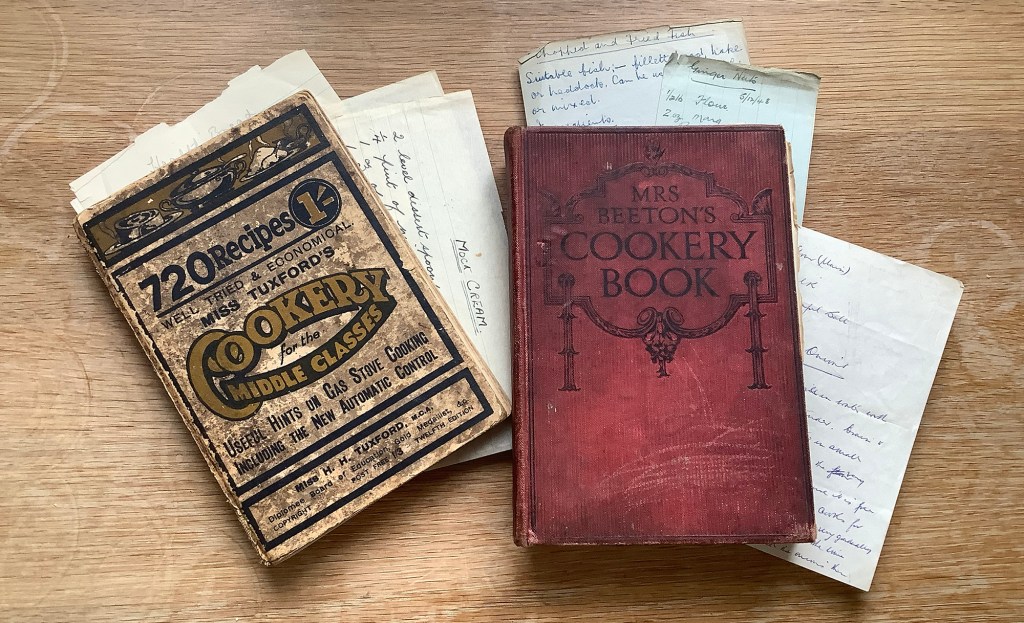
Mrs Beeton and Miss Tuxford
Long before Delia and Jamie — and Fifties’ favourites, Fanny and Johnnie — made their marks on this world, Mrs Beeton and Miss Tuxford were advising housewives how to be… er, better housewives.
Born in London, in 1836, Isabella Mayson married wealthy publisher Samuel Beeton in 1856, and began writing articles on cooking and household management for her husband’s publications. My copy of Mrs Beeton’s Cookery Book is still interleaved with recipes and notes written in my grandmother’s elegant hand. It’s musty and dog-eared and packed with recipes and advice about household management, childcare, etiquette, entertaining and the employment of servants.
Hester Harrington Tuxford was born in Chorlton-cum-Hardy, Manchester, in 1881. Miss Tuxford’s Cookery for the Middle Classes published in 1902, sits alongside Mrs Beeton, wallowing in mutual mustiness.
Between them, they have much to say, about much of the above.
Take potatoes. For ‘potatoes, baked’ instructs Mrs B, we should deploy ‘sound potatoes’ and ‘scrub them well, for the brown skin of a baked potato is by many persons considered the best part of it’. After two hours in a moderate oven, we should serve them ‘in a napkin… for if they are kept a long time in the oven they will have a shrivelled appearance’.
In the matter of curry, she details a ‘curry sauce for meat, poultry and fish’, and recipes for both chicken and rabbit curry. Meanwhile, Miss T offers curried fish as a handy way to use up leftover fish, served with (whisper it) boiled rice. Her Kedgeree recipe also calls for ‘cold, cooked fish’ expertly mixed with ‘cold cooked rice’ (staple of many a Sunday tea at our house back then and far from my favourite — but you ate what was put in front of you).
Mrs B also serves up a number of macaroni dishes. That’s pasta, I believe. The first pasta production line came to Britain in 1936, but it was another 20 years — with the end of rationing — before the first pasta houses opened in London. And let’s not forget that many Italians — along with other nationalities — came to Britain during the war, bringing with them culinary staples such as home-cooked pasta, rice and pizza.

Then there’s ‘brown bread’. Miss T’s ‘Hovis scones’, mixing ‘Hovis flour’ with sugar, butter and eggs were clearly a sweet treat, but Hovis loaves were out there long before Ridley Scott directed a young lad to push his bicycle up a cobbled Dorset hill to the tune of Symphony No 9 in E minor. The Hovis company began mass-production in Macclesfield in 1886. An advertising campaign in 1895 proudly announced them as winners of the ‘highest award at the food and cookery exhibition’ in May that year. Their bread, they said, was not only a ‘cure for indigestion’, but ‘supplied to the Queen and Royal family’.
In competition with Hovis were Spillers, who had introduced their Turog brand of brown bread at the turn of the twentieth century.
During the Second World War, a ‘national loaf’ was created, a fortified wholemeal bread made from wholemeal flour with added calcium and vitamins, intended to prevent nutritional deficiencies like rickets. Working with the government, the Federation of Bakers published four recipes for wholemeal bread, which became the only recipes that could legally be used to make bread in the UK. Meanwhile, white bread became unavailable. There was a Royal story to be told here too. When Eleanor Roosevelt, American First Lady, visited Buckingham Palace in 1942 she was noted to have been ‘served on gold and silver plates, but our bread was the same kind of war bread every other family had to eat.’ I mention this because it was 1956 before the National Loaf was abolished,
A recipe for stewed sea kale (I grant you not the slimy stuff we slither over at low tide) involves bringing it to boil in a pan of water, then stewing in milk and water for one and a half hours. This is served on toast then covered in a sort of béchamel sauce, sans the nutmeg. I’m not sure even my eclectic palate can wrap round that one.
Back with Mrs B for pudding, she details prune tarts (like apple tart, but with prunes) and a ‘prune mould’ (jelly), both of which may well have had an unintended ‘medicinal effect’.
Curry to go
Contrary to our meme, Indian restaurants were well established in England by the 1950s. The first Indian curry house, the Hindoostanee Coffee House, opened in London in 1810. Before then, curry had been served in some London coffee houses.
In 1932, Khandoker Nazir Uddin moved to Manchester from Bangladesh. Five years later, he opened The Bombay Restaurant. It was here that he went on to found Nazir, makers of curry paste, pickles and ready-made curry meals.
Batchelors launched their Vesta curry in 1961, so missing this Fifties-fest by a squeak, but I can’t help think this was in response to a growing interest in Indian food through the previous decade. They looked and tasted nothing like the cuisine they sought to emulate.
And curry was indeed a favourite treat in my family. Every now and then, Dad would pop off to the local curry house with a saucepan, a small lidded casserole dish (which weirdly, I still have) and a tea towel. He’d return some time later with a pan of Madras sauce, a casserole dish filled with chicken Biryani topped with an omelette, and the tea towel folded around a stack of crispy poppadoms. Indian restaurant, curry, rice and takeaway, all rolled into one…
Tea and kebabs

What else then? Ah yes… tea bags. Tetley brought the idea of the tea bag to the UK in 1939, followed later by Lipton, who introduced their ‘flo-thru’ bag in 1952. Despite their best efforts, we Brits remained stubbornly wedded to our loose leaves. Even by 1968, only 3% of all tea brewed in the UK was said to be by teabag.
As for kebabs, the word is said to come from the Arabic, variously translated as ‘to fry’, ‘burn’ or ‘roast’. Leaving aside my suspicion that our own sword-carrying warriors of old perhaps threaded their fresh-caught meat and fish onto their weapons, to cook over an impromptu fire, the kebab as we know it is said to have first appeared in the UK in the 1940s, as immigrants from Turkish, Cypriot and Kurdish communities arrived here in search of a new life. The Royal Nawaab restaurant blog suggests that the origin of the kebab goes back to a Turkish script of Kyssa-I Yusuf in 1377, ‘the oldest known source where kebab is stated as a food item’.
Holy fizz-pop, Batman! Bottled water?!
Bottled water was apparently first produced in 1622, at the Holy Well in Malvern, as human beings continued to seek ways to ‘heal’ and protect themselves from the weariness of life.
But ‘Sscchhh…’ what have we here? Our history trail to bottled water leads us back to 1783 and one Johann Jacob Schweppe, whose company went on to produce arguably the best-known mixer in the business, a product which burst onto our TV screens in 1963, in glorious black and white, accompanied by the dulcet tones of William Franklyn. Schweppe founded his company in Geneva, using a process developed by English chemist Joseph Priestley, to make ‘bottle carbonated mineral water’. In 1792, he moved to London, with offices in Bristol where his company bottled ‘Bristol Water’ taken from the spa at Hotwells — the hot springs which bubble up through the rocks of the Avon Gorge underneath the Clifton Suspension Bridge. In 1843, Schweppes went on to commercialise ‘Malvern water’ at the Holywell Spring in the Malvern Hills.
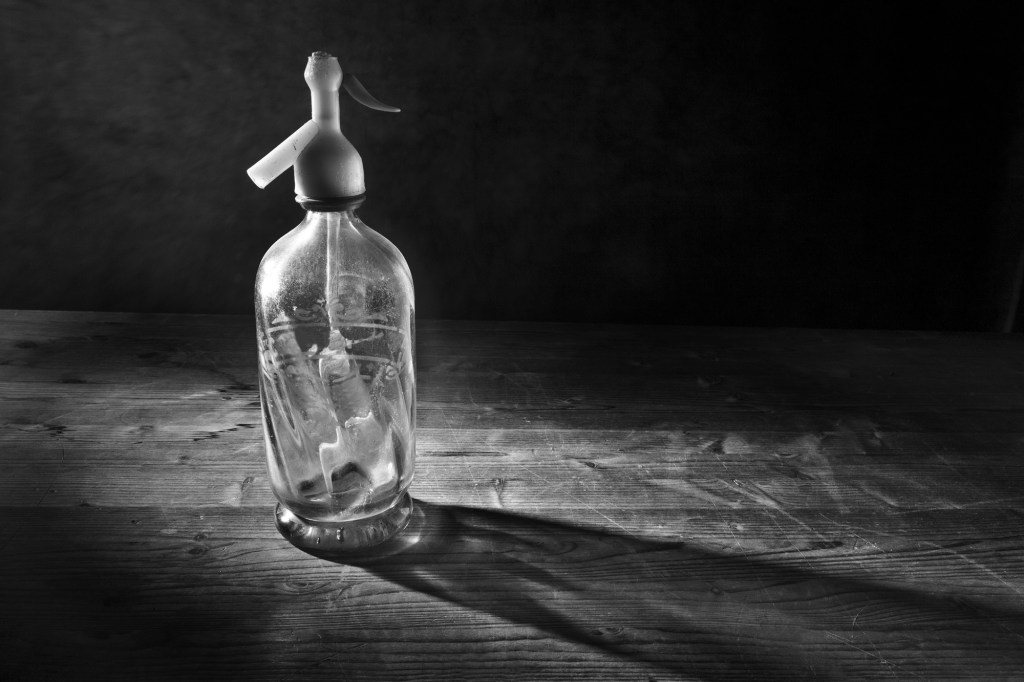
Perhaps our fridges weren’t perma-stocked with bottles of water (indeed, not everyone had a fridge), but many a household boasted a soda syphon. This tricksy device created ‘pop’ from ordinary tap water, by forcing carbon dioxide into a reusable bottle filled with water, a conjuring act we kids were only allowed to witness on high days and holidays. And, speaking of pop, let’s give a nod to the ‘Corona man’, who delivered to our door bottles of Dandelion and Burdock, Lemonade and fizzy Orange, and took back our empties too (an early example of recycling, before it was even invented).
And finally… ‘easy-to-serve fingers’!

Ah, fish fingers… my favourite pre-pubescent, go-to tea, the first breaded and quick-frozen ‘easy-to-serve fingers ‘ having been launched by Clarence Birdseye in 1955. A news clip from the Yorkshire Post and Leeds Intelligencer on Tuesday 4 October that year, describes the introduction of ‘frozen fingers’, a new product that would ‘benefit the British fishing industry’ and provide ‘more employment at the fish factories of Great Yarmouth, Lowestoft and Grimsby’.
…but there’s always room for ‘afters’… just when you thought I’d emptied my plate…
Grab yourself a glass of ‘Corporation Pop’ and stick with me just a few moments longer as I’ll share a few of my own, each firmly rooted in personal experience…

1. The hunt for faster food was a thing even then and every aspiring Fifties housewife boasted a pressure cooker, designed to cook foods at speed whilst effectively removing from them any notion of flavour.
2. Vegetables were well and truly salted, both before cooking (to remove bugs and dirt) and during (as above, to remove and then replace any discernible native flavour).
3. Brassicas in particular were not considered cooked until they had fully surrendered. The resulting colourless pulp was then either made vaguely palatable through a liberal coating of cheese sauce (see cauliflower), or left as they were, to the horror of all children, everywhere (see Brussels sprouts).
4. If you were lucky, all that flavoursome vegetable water might be blended into a delicious gravy, with the meat fat (quelle horreur!) and juices, thickened with flour. Otherwise, it went down the plughole and out came the Bisto.
5. No roast dinner was complete without a slice of bread and what was left of that ‘proper’ gravy (after you’d cleared your plate, of course).
6. ‘Spam’ came in tins. And there really was nothing to beat a fried Spam sandwich for a Saturday evening treat.
7. Lucozade always made you feel better. But first you had to recover sufficiently to break through the yellow cellophane.
8. Who said there was no such thing as ‘processed foods’ eh? I give you Kraft Dairylea, Summer County margarine, tinned peas ‘fresh from the garden’, Kellogg’s Frosties, Carnation ‘milk’, Royal Lemon ‘flavour’ Pie Filling and Bird’s Instant Whip.
9. And yes. There was always room for ‘afters’.
 Hackette on the How
love this! so clever!!Sent from my Galaxy
LikeLike