It was early in May when I finally succumbed to the allure of ‘Zoe zeal’ radiating from the Gremlin.
For months, I’d been daily spectator to his studious recording in the Zoe app of every last morsel eaten. I’d grown used to the weekly game of ‘What did he buy at market today?’ Accustomed to the fridge bursting with vegetables and fruits of every persuasion — roots, greens and legumes, salads and capsicums, tomatoes plum, cherry, black and beefsteak, berries, seeds and citrus, apples, pears and bananas — every day an exercise in ‘How much of this damn stuff can I get into one meal?’
And that’s before we get started on the beans, nuts and pulses, and whatever meat, fish and dairy we’d gone for that week.

If you’ve neither seen nor heard of Zoe1 — or its co-founder Tim Spector2— then, honestly, I’m not sure where you’ve been hiding. For this is the largest in-depth nutrition study in the world, built on the premise that each of us has a different gut microbiome — even identical twins — and that ‘nothing is more important than the food we eat’.
‘Almost everything we’ve been told about food is wrong’, says Professor Spector3. Who knew, for example, that two cups of black coffee contain more fibre than a banana?4
Once you sign up to Zoe (Greek for ‘life’), they monitor your blood fat and blood sugar with a series of at-home testing kits over a couple of weeks then, based on the results, help you optimise your health. The idea is that by identifying how different foods affect our unique microbiome, we can choose to avoid them, eat more of them, or learn how to combine them to minimise the blood sugar spikes and avoid the crashes. So, apart from a somewhat wincing hit on the credit card*, what did I have to lose?
A thing of beauty
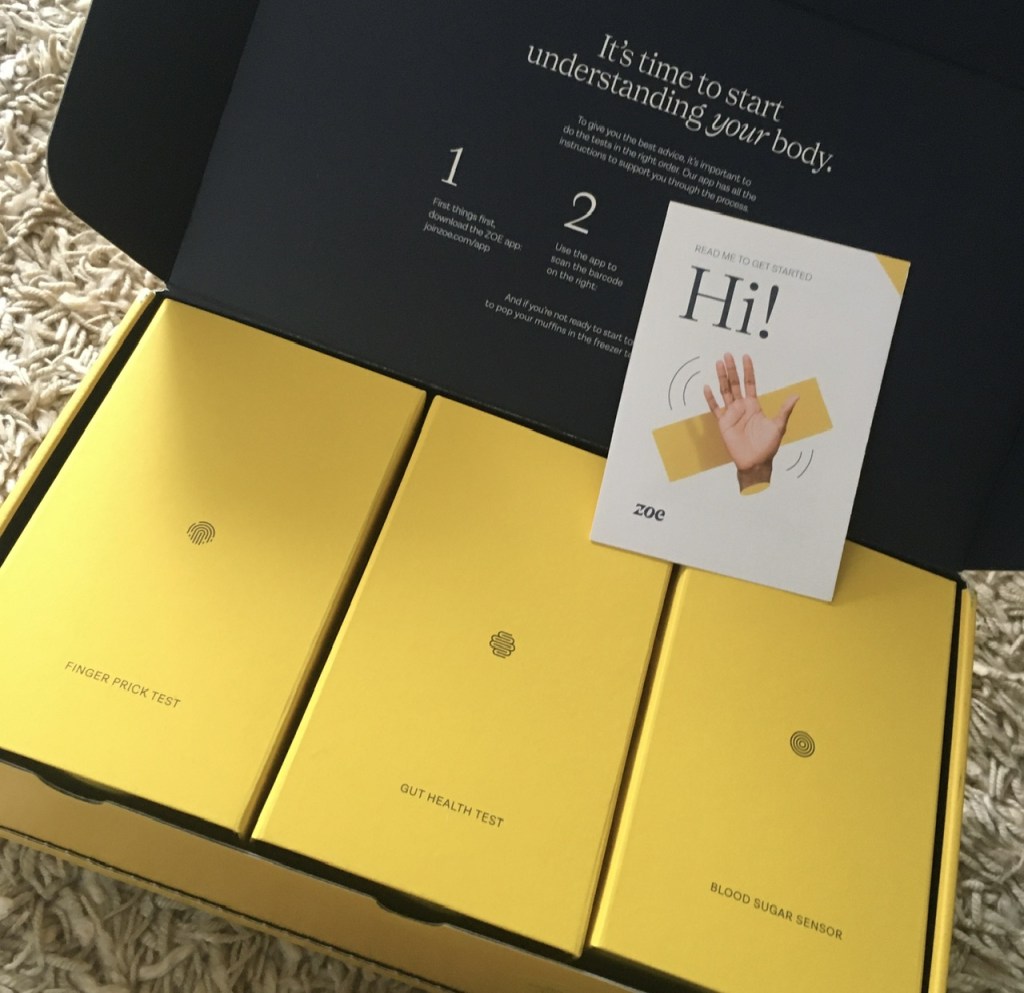
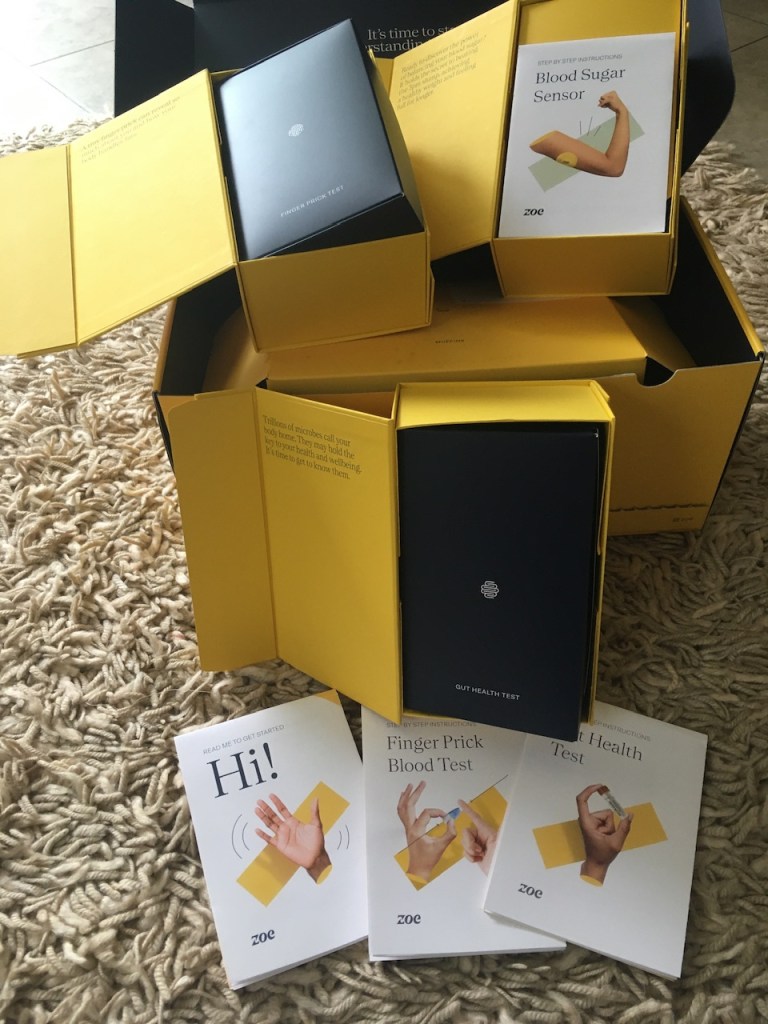
Much excitement then in early August when my test kit finally arrived — a thing of beauty (think Apple product packaging meets Pantone ‘Selfridges Yellow’), which I hardly dared open. Each test — finger prick test, gut health test and blood sugar sensor — comes perfectly wrapped in a beautifully crafted yellow box with its own set of instructions, key points highlighted in that signature yellow.
There are myriad things to do in the app before you start, details about you and the things you like to eat, plus a long list of lessons and videos to work through. And things need to be done in the right order. To be honest, it was information overload and had the Gremlin not been around to walk me calmly through it, that whole beautifully-crafted box might have gone out the window. I also enlisted his help with affixing the blood sensor to my left arm and, later, the finger prick blood test. The pooping I managed on my own.
First things first
The first thing you do is pick a start day, the most intensive. They recommend keeping it relatively free and low key so the tests can be done on time and unrushed. Attach the blood glucose sensor and scan. Check. Fast overnight for minimum eight hours. Check. And then… the muffins. Oh my, the muffins.
The Zoe muffins are specially designed to ‘challenge your metabolism with high doses of fat and sugar over six hours’. And they are the most unappealing, unappetising muffins ever known to the world of muffins. They give muffins a bad name.
The Gremlin heats my three breakfast muffins in the microwave as instructed (my microwaving abilities having evaporated at the sight of said muffins), and presents them on a plate. The timer is ticking. Fifteen minutes to eat them. Which sounds fine at first bite, but by muffin number three I am literally gagging, stuffing every last crumb against the ticking clock, raising a triumphant hand for a high five as I finish chewing. A minute over time.
Even the water I’m washing them down with fails to remove the overly-sweet aftertaste.
Next up, it’s fast for four hours. Followed by (joy of joys) more muffins! Only two this time, somewhat crumbly and equally as unpalatable, they leave an even more cloying sweetness in the mouth. Another fast for just two hours then it’s on with the finger prick test.
Everything you need is in the box: alcohol swabs, three lancets (in case you have to repeat your stabbing on a different finger), cleansing wipes, collection card, two dinky plasters, blood sample return bag and a prepaid sturdy brown return box. And designer leaflet. Of course.
The Gremlin stabs my middle finger. I squeeze droplets of blood onto the collection card window and we watch it seep slowly across into the next window. After leaving it to dry for an hour, I can parcel it up and take it to the postbox. But, for now, the one thing I really want is a cup of good old English Breakfast. With milk.
I can eat normally for the rest of the day, but all those muffins have had a strange effect on my appetite. I eat a chaotic meal of pasta with pesto and bacon, heaped with parmesan, and far too many salt and vinegar crisps, washed down with a large glass of wine — possibly the very antithesis of healthy eating! And I can’t quite put my finger on my mood, but it’s definitely not up!
The poop test
I can’t believe I’m writing this but it’s part of the programme so I must. It took a while. At one stage, I was absolutely sure I would never poop again, my ability to poop having retreated along with my microwaving skills. Thank you, muffins.
Having reached that certain age when you have the joy of poo testing for bowel cancer every couple of years, I’m used to the standard NHS home test kit, but Zoe take poop testing to a whole new level. Perfectly presented in the ‘gut health test’ box are blue gloves, stool collection tube, ‘sampling sheet’, plastic bag with absorbent pad and another sturdy brown box.
It’s the sampling sheet that really elevates things. A sort of paper nappy-come-sling, you double-sided tape it to the loo seat where it, well, catches things. The pea-sized lump you select with the spatula (integral to the collection tube lid) is then mixed with the liquid in the tube, ready for parcelling and posting. If nothing else, I’m getting my steps in heading down to the postbox.
Each of these tests must be logged on the app and marked as complete. Homework done. And, meanwhile, I’m regularly scanning the blood glucose sensor with my phone and watching the graph move up and down as I eat, drink and go about my day.
Let the journalling begin…
I progress to ‘Zoe 101’, first getting used to recording every last gram of food and drink in the app before ‘Zoe 102’ offers a number of optional ‘blood sugar challenges’ to see how my body reacts to particular combinations of food.
I’m partial to a bacon butty on a Sunday morning, so I delay my chosen five-day purgatory of nothing but oats for breakfast until the Monday. And I mean nothing but oats. No salt. No sugar. No honey. No milk. No fruit and nuts. Just water to cook. The second day gets a little more interesting, with the addition of a whole avocado. But again. No oil. No sea salt flourish. And the final three days promise riffs on the same theme.
I now know how Oliver and his mates felt in that Dickensian workhouse, closing their eyes and imagining ‘Food, glorious food!’ And, worse, that ‘cruel, cruel gruel’ sends my blood sugar rocketing, crashing right in the middle of teaching a Yin yoga class (accompanied by the noisy rumble of my sugar-crashed stomach). The previous day’s bacon butty, meanwhile, had nonchalantly ambled along the morning’s graph with not a hunger pang to be heard. Go figure.
The idea is that the fat and fibre in the avocado mitigates the sugar rush from the oats. But, by the third day, the thought of spooning in another mouthful of unadulterated avocado and porridge proves too much to bear and the entire breakfast goes in the bin.
Talking bananas
That first two weeks done, I’m warned it might be a few weeks before my results come through, so I really wasn’t expecting them just as we left for three weeks in Greece. Three weeks of drinking too much local rosé, washing down a diet of grilled fish, Greek salad, chicken souvlaki and Greek yoghurt with fruit on repeat.
It’s no surprise to me that my results show room for improvement. For the next few weeks, I must commit to ‘Zoe 201’. Now informed by my gut microbiome results, each time I enter food and drink in the app, I’m delivered an accumulating score. Some foods are ‘gut boosters’ and high scorers, so the figure goes up, but follow that with a ‘gut suppressor’ and the little icon counts rapidly — and somewhat depressingly — down. But the opposite is also true.
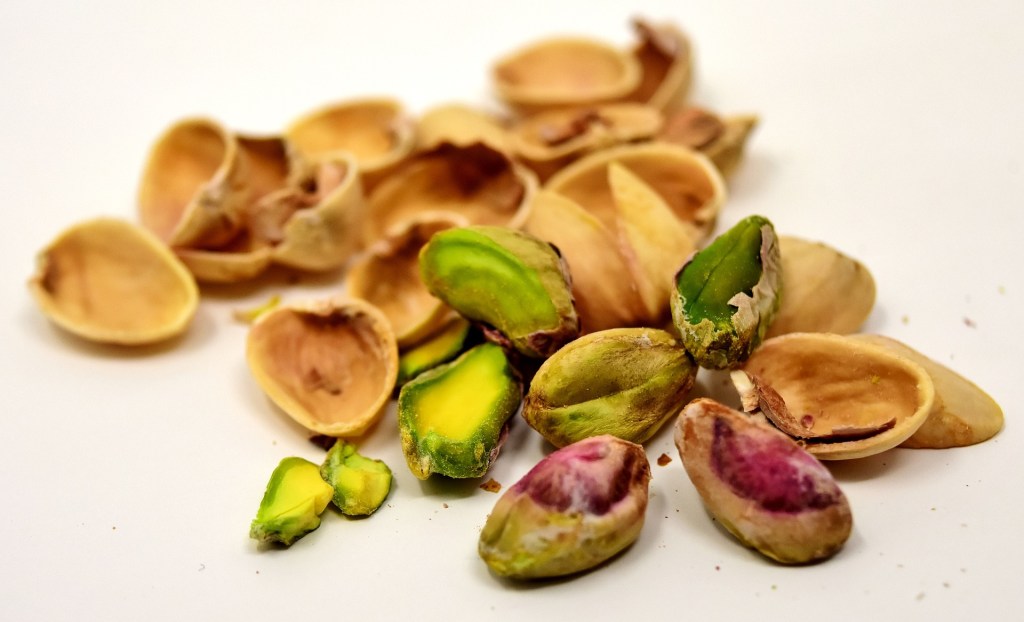
So that cheeky glass of rosé, down at a Zoe finger-wagging ’40’ leaps suddenly upwards again with the addition of a handful of salted pistachios, a healthy eat-as-much-as-you-like ’97’. I’m back at an acceptable score of ’63’. Okay still an echo of that finger wag in the message to ‘drink responsibly’ but still, who’d have thought it? Salted pistachios! No longer a ‘guilty’ pleasure!
Similarly, having once been told to cut down on my tea intake (as in the English Breakfast tea with milk I was practically weaned on), it turns out to be quite good for me, scoring a neat ’76: Enjoy freely’. Yes!! Those old aunties knew a thing or too didn’t they, with their bottomless, hand-knitted-tea-cosied teapots and their China cups?
But wait… add in my four o’clock ‘holiday’ digestive — at a dastardly score of ‘1’ — and my tea score plummets to ’36’ with the advice I should merely ‘enjoy in moderation’. Take that with a handful of crunchy hazelnuts, however, and I’m back up to a magnificent ’80’.
Each item also comes with a breakdown of its impact on my blood sugar, blood fat and gut health. Some things might seem obvious, but I’m intrigued to learn that, alongside the humble banana, pomegranates, melons and blueberries also spike my blood sugar, dragging down my daily score. Raspberries though… good as gold.
Poor effort
By the third week of our holiday, Zoe is singularly unimpressed. My Greek diet, however healthy it might appear, what with all that Greek salad and grilled fish, registers as ‘Bad’, both for its lack of plant diversity and its lack of fibre. My weekly progress has been ‘Poor’: a metaphorical, red-inked ‘Must try harder’ scrawled across my homework. I confess to feeling a little smug, however, imagining how impressed this app is gonna be once I’m reunited with the Gremlin’s bursting fridge!
And, one week on, Zoe is indeed impressed: I average ’74’ for the week —’Excellent’ in terms of ultra-processed foods, plant diversity and protein. Fibre is merely ‘Good’. I can live with that. But can I keep this up for the subscribed twelve months? I’m not so sure.

Are the cracks appearing?
Okay, I admit I was resistant, and there’s still a part of me that remains so. I worried that this level of scrutiny in my diet might feed into disordered ‘picky’ eating. The first two weeks are intense but, once the test results drop into your inbox, it becomes something of a game. Zoe themselves, in one of their relentless ‘lessons’ (this one about improving a meal’s score), say ‘it’s about playing the game’. And I can vouch that chucking a teaspoon of linseeds on just about anything works a treat. Surprisingly tasty too. But…
The theory is that repeated spikes in blood sugar and fats can trigger inflammation in the body and, over time, contribute to the development of diseases such as cancer, diabetes, heart disease and dementia. They also accelerate ageing and cause the blood sugar crashes that make us feel moody and tired, and crave foods we don’t need.5
Zoe isn’t about restriction. You can eat and drink what you want with greater understanding of how it’s impacting your body and energy levels. Nothing is off the menu — although being told that bananas, for example, have a detrimental effect on my blood sugar initially rather put me off eating them.
Oddly, the lower-scoring rosé didn’t trigger the same Pavlovian response… and that’s the issue. Those long-established patterns and preferences are hard to break. Already I’m questioning just how many ‘handfuls’ of brazil nuts I can add to my regular sourdough-based breakfast, how many more chickpeas I can munch, how inventive I can get with a pine nut. Already I’m wondering how I can game the system by just not entering, say, a square of dark chocolate or a handful of crisps.
And those lessons and admonishments just keep coming. I get that it’s about re-education and changing habits, but sometimes I just want a bacon butty without the ‘side’ of guilt.
Aside involving incredibly lengthy ingredient lists and taking much longer to chop and cook, many of the ‘suggested meals’ for mine and the Gremlin’s microbiome attract different scores which means we must compromise. And that constantly adjusting score is fun to begin with but, as with any gaming app, the dopamine hit when it rises is designed to keep you hooked. The disappointment when it drops is visceral. This might not be ‘picky eating’ as such, but it’s definitely in danger of becoming obsessive.
Too early yet to see how it affects my body and energy levels long term. I’m told that after four months, Zoe will send another gut health test so I can measure my progress through the medium of poop. Can’t wait.
Now, where did I put those salted pistachios?
1 https://zoe.com 2 https://tim-spector.co.uk3 Spoon Fed by Tim Spector. Jonathan Cape (27 August 2020) ISBN: 978-1787332294 4 Food for Life by Tim Spector. Jonathan Cape (27 October 2022) ISBN: 978-1787330498 5 https://zoe.com/why-zoe
* There are two separate costs associated with Zoe. First, the testing @ £299.99. Second, membership, with the option for a 12-month plan @ £299.88.
 Hackette on the How